Tech Support EX

  • Subscribe to our RSS feed.
  • Twitter
  • StumbleUpon
  • Reddit
  • Facebook
  • Digg

Tuesday, 19 November 2013

Third-party apps: now easier to find and more secure

Posted on 11:25 by Unknown
Posted by Apoorv Saxena, Product Manager, Google Apps for Business

There are thousands of third-party applications that integrate with Google Apps for Business to help people to do more on the web and accomplish specific business tasks. These include apps like Mavenlink (project management), Insightly (customer relationship management), and myERP (business management). Starting today, administrators will be able to find, manage and deploy third-party applications, like these, directly from the Google Apps Admin console.

To start, over twenty third-party applications will be available in the Admin console. These applications all offer the latest OAuth 2.0 security, single sign-on (SSO), and integration with Google services. Admins can now see reviews from verified users of the applications to help select the best app to meet their needs. As additional applications are updated, they will become available to Admins directly from the Admin console. In the meantime, all third-party applications are available as always in the Google Apps Marketplace.

Many admins have asked for greater control of third-party applications. With this upgrade, third-party applications are moving to OAuth 2.0. This means admins can deploy applications only to specific people or organizational units (rather than the entire company) and developers can design apps to request more narrow access to corporate information.

To learn more about how to add third-party applications that work with Google Apps for Business, visit our Help Center.

If you are a developer and would like to learn more about these changes and to see how to migrate your application for easier development and deployment, visit the Google Apps Developer website.
Read More
Posted in admin, Developer, Google Apps | No comments

Google Maps helps Vilant’s customers track movements of shipment locations

Posted on 09:20 by Unknown
Posted by Antti Känsälä, product director at Vilant Systems

Editor's note: Today’s guest blogger is Antti Känsälä, director of products for Vilant Systems, a Finland-based provider of RFID (radio-frequency identification) information systems for manufacturing and logistics. This post is part of our series on the Transport and Logistics Industry and the ways they’re relying on Google Maps for Business to get people, products and assets to their destinations faster.

When my Vilant colleagues and I attended a trade show in Stockholm recently, we had to carry a bunch of posters, brochures, and giveaways on the plane, because an earlier shipment of duplicate material got lost in transit. To avoid this scenario in the future, we decided that from now on, we’d place a Vilant Tracker on all event packages, so that we could see their progress on a Google Map.

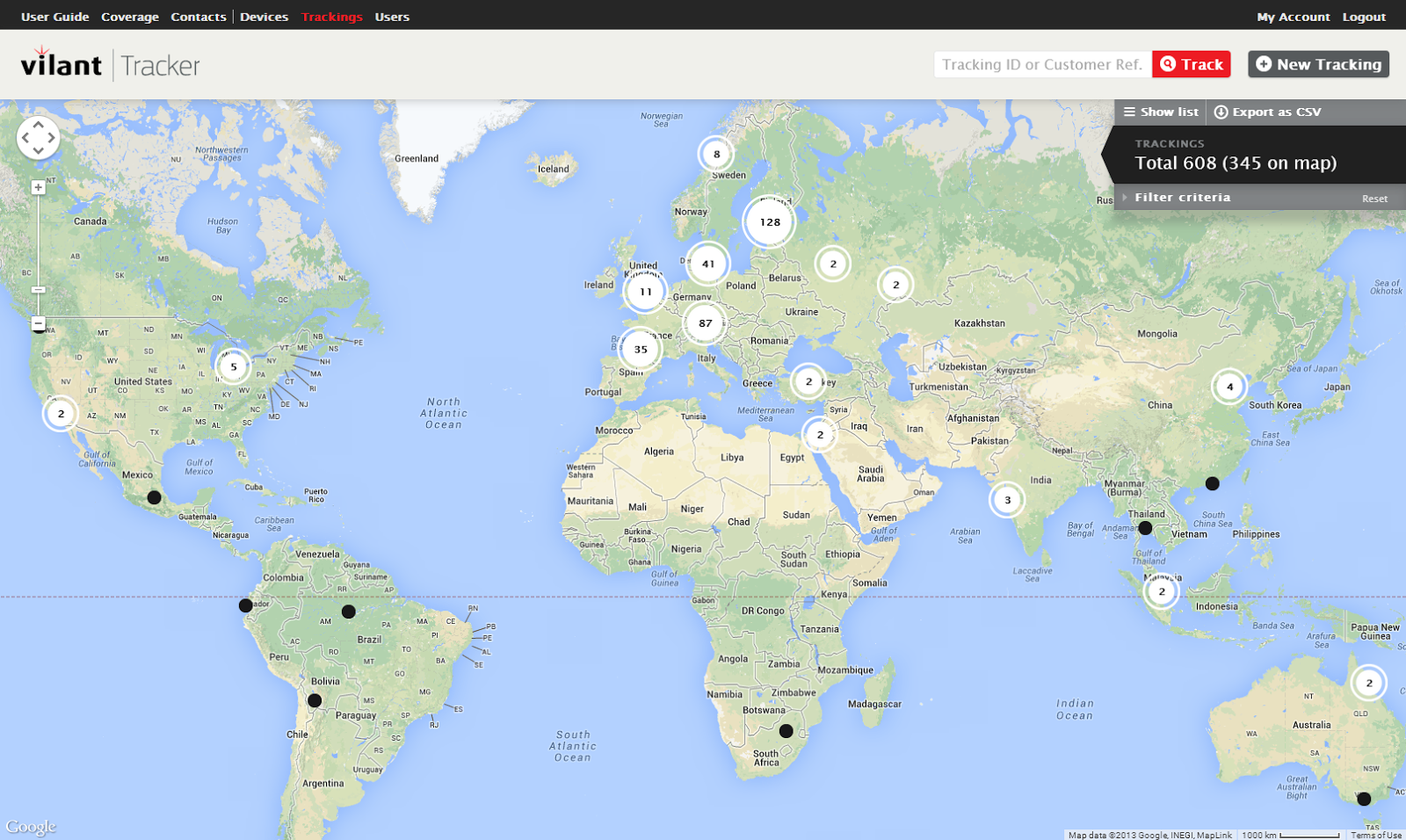
At Vilant, we’ve made it similarly easy for businesses to track the progress of shipments to their destinations using Google Maps and the Google Geolocation API, and for shipping companies to share this information with their own customers. Vilant technology makes shipping more efficient: Vilant’s Tracker devices use GSM (global system for mobile communications) technology, which means they are less expensive to operate and last longer than GPS devices. We also recently developed a unique Air Tracker for one of our customers, and it will be generally available in the future to help track progress of shipments by air.

To add even more efficiency to our Tracker systems, we looked at mapping solutions from several vendors, and we found that the Google Maps and Geolocation APIs were the easiest to customize for displaying the information we receive from our tracking devices. We considered some open-source products, but Google Maps’ image quality was much higher and the resulting maps were more reliable and faster to get online.
Vilant has developed a web-based tracker portal, built with Google Maps, where our customers can go to check on shipping status and create and share customized maps through unique URLs. Some customers also have large track-and-trace platforms, and we can easily integrate them with our trackers using the APIs.

The ability to generate and share maps helps businesses stay on top of shipments without time-consuming dialogue with shippers and warehouses. One of our customers, Tieturi, which provides business training and coaching, ships dozens of computers to training locations and needs to know that the computers will arrive before classes begin. The Google Maps API enables this by showing shipment locations practically in real time.
Another Vilant Tracker user, ABB, ships motors and generators and needs to tell customers when they will arrive. Instead of taking calls from customers and then calling trucking companies, ABB can simply email its customers a link to a Google Map showing the shipment’s location. It reduces administrative work, and sets ABB apart from the competition.

Like our customers, we see Google Maps as a big competitive advantage. The ability to visualize shipment locations and see delivery progress at a glance is sure to bring us new customers and help us win a larger share of the logistics market.
Read More
Posted in customer love, Google Maps for Business | No comments

Rio de Janeiro’s Center of Operations (COR) sets the stage for a smarter city with Google Maps

Posted on 07:00 by Unknown
Posted by Pedro Junqueira, Cheif Executive of the Center of Operations Rio de Janeiro (COR)

(Cross-posted on Google Brasil Blog)

Editor's note: Our guest blogger today is Pedro Junqueira, CEO and COO at the Center of Operations (COR) in Rio de Janeiro, Brazil. Established in 2010, COR monitors the daily activity of the city and potential crisis situations including traffic, major events and natural disasters. COR integrates the activities of 30 organizations. Today, 400 professionals work at COR in 3 shifts. See what other public institutions that have gone Google have to say.

Home to more than six million inhabitants, Rio de Janeiro is a vibrant city set in a tropical climate along the coast of Brazil. Rio is known for hosting large festivals and international events that attract hundreds of thousands of people, like the 2013 Confederations Cup, the recent Papal visit, and the beloved Carnaval. We’re currently planning for the 2014 World Cup and 2016 Olympic Games.

At the city’s Center of Operations (COR), it’s our job to keep the city running efficiently throughout the year, whether it’s during a major festival, when traffic is at peak levels, or during the summer rain, when flooding can create emergency situations. It’s no easy feat, but thanks to collaboration and teamwork, we’re able to get in front of potential crises and respond to emergencies when they do occur.

Technology plays a pivotal role in helping us do our job. We use Google Maps for Business to build and share geospatial data with partners that allows us to have a common operating picture and detect potential problems. We can act before they turn into real emergency situations. Each summer, for example, Rio is deluged by summer rains, leaving homes and streets flooded, inaccessible and damaged. With Google Maps for Business and a team that monitors meteorological conditions each day, we’re able to keep a close watch on flood-prone areas with dense populations. And when rain reaches a critical level, the team warns local officials to prepare for possible evacuation operations.

All the information needed to assess risks and take action is shared on one Google Map, enabling the various teams from the Municipal Guard, Civil Defense, Mayor’s office and others to easily coordinate and respond. We can even use Google Maps for Business to study preventative measures and minimize the impact of events that could affect the operational routine of the city. It’s all on a single map that combines data from a range of different agencies and sources.
Tracking the real-time state of the city and responding to emergencies immediately couldn’t be done without reliable technology like Google’s mapping solutions. Google Maps for Business integrates with our internal systems, and employees already rely on these tools in their personal lives, so using them for work comes naturally. Google helps COR make faster, better more informed decisions every day. It’s good for us, and it’s good for the people of Rio de Janeiro.

Read More
Posted in #gone google, customer love, Google Maps for Business | No comments

Monday, 18 November 2013

Google Maps for Business helps drive global growth for T Dispatch

Posted on 11:05 by Unknown
Posted by Mario Brandao, CTO of T Dispatch

Editor's note: Today's guest blogger is Mario Brandao, CTO of T Dispatch, a fast growing global provider of fleet management software. This post is part of our series on the Transport and Logistics Industry and the ways they’re relying on Google Maps for Business to get people, products and assets to their destinations faster.

If you’re like me, wherever you are in the world, you often depend on the knowledge of taxi and minicab drivers to get you where you want to be. And the firms that manage, equip and train these drivers are on a constant quest to improve the way their cars get around the many cities they travel around in. We started our company back in 2010 with the aim of creating an affordable mapping and dispatch technology that could be used by all sizes of fleet companies to become more efficient and more profitable.

Our clients tell us that drivers can spend around 30% of their time with the car empty; this is ‘dead’ mileage, which is costly and bad for the environment. We use Google Maps and an intelligent autodispatch algorithm to send jobs to the nearest driver, to find jobs within their catchment area and even to allocate jobs on their route home at the end of a shift. Controllers can create and dispatch a booking within 15 seconds, and we’re able to reduce time spent ‘empty’ by up to 50%.
We’ve found our clients love all the different features, too. The Google Tracks API makes it easy to pinpoint exactly where their drivers are at any one time, allowing jobs to be allocated more efficiently by dispatchers. And as this location data can be saved for up to ten years, clients can also use the technology to recognize trends and patterns and create more efficient processes in due course. Google’s snap-to-road tool even helps call centre dispatch managers to find out which side of the road the driver is on, which is especially helpful in some cities with complicated one way systems.

In the future we plan to integrate live weather reports, traffic information and use historical data to predict where busy areas will be, allowing fleets to anticipate where to send the drivers.

From a driver’s point of view, not only does the software help calculate the fastest route with the least mileage, but with Google Directions, drivers are able to calculate directions between locations before setting off, which prevents them from getting lost. Most importantly, most people are familiar with Google Maps and find it easy to use - which is important in a job when you’re often dealing with stressful circumstances like traffic and road closures.
Google Maps provides us with a comprehensive feature set too, so we’re able to offer our customers features like Directions as part of the package, which is a huge selling point for us. Furthermore, if we used some of the competition’s offering, every customer would have to pay a licensing fee but with Google this is avoided.

Google Maps has played a crucial role in helping us grow and move into new markets seamlessly - we’ve won clients across six continents, in over 30 different countries. I’m now looking forward to taking our technology with us to our next area of expansion - South America.

Read More
Posted in customer love, Google Maps, Google Maps API, Google Maps for Business, Google Maps Tracks API, T Dispatch | No comments

Smarter ways to plan and optimize transport and logistics with Google Maps for Business

Posted on 10:26 by Unknown
Posted by Elena Kelareva, Product Manager, Google Maps for Business

Editor's note: For transport companies, getting things from point A to point B in the safest, smartest and most efficient way is a top priority. This week we're showcasing the Transport and Logistics Industry and the ways they’re relying on Google Maps for Business to get people, products and assets to their destinations faster.

GPS technology and digital mapping have had a huge impact on making transport and logistics companies more efficient. This week we’ll be demonstrating innovative ways transport and logistics companies can use maps for smarter fleet and asset management, routing, tracking and planning. To kick things off, we’re announcing a new snap-to-road feature of the Google Maps Tracks API that can help organizations gain access to valuable data about where they’ve been.

Launched last year, Google Maps Tracks API allows users to store, display and analyze GPS data on a map. For a shipping company with a fleet of delivery trucks, for instance, the Tracks API offers a way to record all the routes and places its vehicles have traveled to and from. Stored in the Google cloud and visualized on a Google Map, fleet managers can access their information reliably, securely and using a map interface they’re familiar with.

With snap-to-road, transport and logistics companies can have an even more accurate view of their GPS information. Based on GPS data points, it identifies the most likely road a truck has been traveling on and plots the route on a map. This allows an organization to easily decipher driver behaviors and routing trends.
The images above show the same GPS data from a delivery truck before and after applying snap-to-road. With snap-to-road, the delivery route is correctly shown on a Google map, indicating that the driver traveled down a major highway.
For a transport company, having more accurate ways to track and understand GPS data means they can plan and predict routing and logistics with greater precision. Contact our sales team for more information about the Tracks API and how Google Maps for Business solutions can help your business.
Read More
Posted in Google Maps, Google Maps API, Google Maps for Business, Transport and Logistics | No comments

Saturday, 16 November 2013

Orbotix taps Google Apps to bring robots to life

Posted on 06:02 by Unknown
Editor's note: Colorado has enticed all sorts of pioneers since its Wild West beginnings. We’re excited to highlight a handful of these trailblazers - the intrepid entrepreneurs, aspiring micro-brewers and ambitious thought leaders - who have helped create the adventurous and innovative culture the Centennial State is known for. Today, we hear from Ian Bernstein and Adam Wilson, co-founders of Boulder-based Orbotix, a robotics toy company.

Can you tell us about Orbotix and how the company got started?
Orbotix is a new kind of robotics toy company: we’re creating a game platform that combines physical objects, smartphones and a software marketplace. We launched in 2010 with our first product, the Sphero ball, a robotic ball you can control with a tilt, touch or swing from your smartphone. You can drive the Sphero ball through a virtual obstacle course or let your dog chase it across your actual yard (under your control, of course) — it lets you both engage in the virtual world and play in the real one. We just released Sphero 2.0, and with a team of 35, we’re just getting started.

Why did you choose Google Apps? How are you using it day-to-day?
We use Google products like Gmail, Drive and Docs in our personal lives, so it was natural to use Google Apps for Business when we started Orbotix. We rely on Drive to securely store, centralize and share our executive documents — everything from legal forms to non-disclosure agreements. We use Docs to brainstorm, create and collaborate on new ideas, or to upload and store product specs that multiple people need to access on a regular basis. The fact that we can create and edit a single document at the same time has dramatically increased our efficiency and reduced the amount of time it takes to finalize a project. We’re a very collaborative team, and Google helps us keep a very team-oriented work environment. Docs is especially vital when we’re on the road, attending events or working remotely. The fact that we can pull up important docs on our mobile devices is crucial to keeping our business running 24/7.

How do you stay connected with your employees outside of the Boulder office?
Hangouts are integral to keeping the company connected, especially as we’ve expanded beyond Boulder — and into China. Our team there has the Hangouts app on their smartphones so they’re connected and available for a quick chat or for a virtual tour around a factory on the other side of the globe. It makes a world of difference to see each other face-to-face rather than just hear a bunch of voices on a conference call, and the experience is such an organic, seamless part of our daily routine. We saw it ourselves just a few weeks ago, when we were in China to check in with the team and do a global press tour: we found ourselves relying entirely on Hangouts to keep in touch with the Boulder office. Ian would be in one room on a Hangout with our CEO, I'd be in another room on a Hangout with our engineers. It was like we hadn't left Colorado.

Has Google Apps helped in your recruiting efforts?
We're always looking to add tech-savvy programmers and talent to our team, and the kinds of people we're looking for expect us to use cool and cutting edge-technology like Google Apps. I know that if I was looking to join a new company it would be a red flag if they were using anything different. We all use Google in our personal lives, so it’s natural that we want to extend that experience to our professional lives.

Do you use Google Apps to partner and collaborate with groups outside of your company?
Absolutely. We recently launched Sphero Rangers, which teaches kids of all ages how to program using Sphero robots. We go to local classrooms and host meetups in the Boulder area, but because we can’t travel to every city where there’s interest, we made a universal Rangers training deck using Google Presentations. That way, there’s a single master document we can share with our partners just by sending along a URL, and we know they always have the most up-to-date version. The Chicago Museum of Science and Industry, for example, have hosted a handful of programming classes for kids, thanks to our handy shared Google Presentation.
Read More
Posted in #gonegoogle, customer love | No comments

Friday, 15 November 2013

Chico’s cuts costs and goes global with Google Apps

Posted on 07:59 by Unknown
Posted by Eric Singleton, Chief Information Officer and Alan Mariotti, Vice President of IT and Security at Chico’s FAS Inc

Editor's note: Today’s guest bloggers are Eric Singleton, Chief Information Officer and Alan Mariotti, Vice President of IT and Security at Chico’s FAS Inc, a retailer established in 1983 with a nationwide family of brands that include Chico's, White House | Black Market, Soma Intimates and Boston Proper. See what other organizations that have gone Google have to say.

Chico’s FAS first opened its doors in 1983 in a 800 square foot tobacco shop in Sanibel Island, Florida, where folk art, sweaters and accessories from Mexico filled the store’s shelves. The clothing took off, and within two years, a second store opened nearby. Now, 30 years after getting started, we employ 22,000 people, operate 1,470 stores and own four specialty retail brands: Chico’s, White House l Black Market, Soma Intimates and Boston Proper.

Our technology changed quite a bit over the years, and in early 2013, we realized we were limping along with a very outdated email system and escalating infrastructure and storage costs. We considered our options: we could keep the status quo and upgrade from Microsoft Exchange 2003 to the 2013 version—which would cost millions—or go with a lower-cost option that would both help our distributed workforce collaborate faster and eliminate our need for resource-intensive servers. We tested Google Apps with 100 employees in one of our business groups and it passed all of our testing and scalability metrics within a few short months. The enthusiasm and efficiency gains alone convinced us it was the obvious and most cost-effective solution.

Our decision to move to Google Apps is also part of a larger cultural shift we are driving at Chico’s, where we’re looking toward technology to enable swifter innovation and invention across the company. With traditional enterprise environments, information is siloed, existing in separate servers and applications, leaving a business to operate as the sum of many independent parts. We’re moving away from this toward a more progressive hybrid cloud model, with Google at the foundation. It’s this new environment, positive feedback loops accelerate, and we can bring together multiple solutions and data sources, all built in the cloud, and look at our business holistically. That’s our vision, and Google is a big part of it.

Even though we have completed our entire enterprise deployment, our journey with Google has just begun and we’re already seeing some great benefits. Our ability to collaborate and share sensitive information across our global team has significantly improved since moving to Google Apps — and we’re saving money at the same time. Our team in Hong Kong, for example, is responsible for visiting and monitoring our factories to ensure they’re compliant with numerous security and performance standards. Before “going Google,” we found ourselves physically travelling back and forth quite often to meet and review access to important documents in person. Now, the U.S. team jumps on a Google+ Hangout with its Hong Kong counterpart, pulls up the essential information from Drive, and has a productive meeting from halfway across the world, all while resting assured that the information is safe and secure in the cloud. Additionally, cost on travel in dollars and time away from campus is greatly reduced.

The benefits of moving to Google Apps continue to reveal themselves to the global team each day. That’s part of the reason we’re so excited about our new platform: not only do we know our information is secure or that our employees are collaborating in new ways over Hangouts and in Docs—we know this is just the tip of the iceberg. We’re driving a new culture of innovation and invention, and Google is one of the cornerstones of that vision.
Read More
Posted in #gonegoogle, customer love, Google Apps, retail | No comments
Newer Posts Older Posts Home
Subscribe to: Posts (Atom)

Popular Posts

  • Keeping you safe in 2013
    Posted by Eran Feigenbaum, Director of Security, Google Enterprise Most businesses these days rely on technology to get their work done. An...
  • Mapping a clear strategy for business growth with Google
    Posted by A.V. Dharmakrishnan, Chief Executive Officer, Madras Cements Editor's note: Today’s guest is A.V. Dharmakrishnan, Chief Exec...
  • Playworks Transforms more than Recess with Chromebooks and Apps
    Posted by Richard Ng, IT director, Playworks Editors note: Today’s guest blogger is Richard Ng, IT director at Playworks, a nonprofit organ...
  • GeoEye Using Google Earth Builder for Commercial Distribution of their Data
    Posted by Dylan Lorimer, Google Earth and Maps for Business Product Manager Since 2008, Google has worked with GeoEye to publish millions ...
  • Hangout On Air: Lessons from a retail CIO on moving to the cloud with ease
    Posted by Meghdutt Brahmachari, Product Marketing Manager, Google Enterprise Change is never easy, but when a business has tens of thousand...
  • Google Apps for Education helps Pt England School raise achievement levels
    Posted by Dorothy Burt, professional development leader at Pt England School Editors note: Today’s guest blogger is Dorothy Burt, a profess...
  • FedEx.com re-imagined with Google Maps Engine
    Posted by Pat Doyle, Manager IT, FedEx Editor's note: Today we announced the availability of the Google Maps Engine API , letting organ...
  • Auto manufacturers take a new turn with Google Maps
    Posted by Mickey Kataria, Senior Product Manager, Google Maps for Business You should have access to comprehensive, accurate and useful info...
  • Amtrak maps trains from coast to coast with Google Maps Engine
    Posted by Steve Alexander, Creative Director of E-commerce, Amtrak Editor's note: Today’s guest blogger is Steve Alexander, Creative D...
  • Introducing online sign-up for Google Maps Coordinate
    Posted by Dan Chu, Senior Product Manager, Google Maps for Business Google Maps Coordinate makes it easy to manage mobile teams more effici...

Categories

  • #gone google
  • #gonegoogle
  • #Google Apps
  • #innovationupgrade
  • #moregoogleapps
  • #SysAdminDay
  • #tbt
  • #throwbackthursday
  • #top10trust
  • 100% web
  • admin
  • admin sdk
  • Android
  • Apps
  • Apps Adventures
  • Asia Pacific
  • Audi
  • Audi Connect
  • Australia
  • big data
  • Big Query
  • bigquery
  • Boston
  • browser
  • Chrome
  • Chrome for Business
  • Chrome Frame
  • Chrome OS
  • chromebooks
  • Chromebooks for Education
  • chromebox
  • City 24/7
  • Clearing Kosovo
  • Cloud
  • cloud computing
  • cloud computing gonegoogle
  • cloud computing gonegoogle Google Apps
  • cloud computing gonegoogle Google Apps google docs small business success story
  • cloud computing gonegoogle Google Apps google docs small business success story switch
  • cloud datastore
  • cloud platform
  • cloud print
  • cloud services
  • cloud sql
  • collaboration
  • Colorado
  • contacts
  • customer love
  • Customer story
  • Customer testimonial
  • Developer
  • developers
  • Docs
  • documents
  • drive storage
  • Earth
  • earth and maps
  • education
  • enterprise
  • events
  • FedEx
  • Fedex.com
  • franchises
  • Gartner
  • GE
  • Global Partner Summit
  • gmail
  • Gone Google
  • gonegoogle
  • Google App Engine
  • Google Apps
  • Google Apps Blog
  • Google Apps Engine
  • Google Apps for Business
  • google apps for education
  • Google Apps for Government
  • Google Apps Reseller
  • Google Apps Script
  • Google Apps Vault
  • Google Calendar
  • Google Cloud Platform
  • google cloud storage
  • google commerce search
  • Google Compute Engine
  • google docs
  • google drive
  • Google Earth
  • Google Earth Enterprise
  • Google Earth Pro
  • Google Enterprise
  • Google Enterprise Search
  • Google Forms
  • Google Green
  • google groups
  • Google Maps
  • Google Maps API
  • Google Maps Coordinate
  • Google Maps Engine
  • Google Maps Engine public data program
  • Google Maps for Business
  • Google Maps Tracks API
  • Google Places API
  • google play for education
  • Google Prediction API
  • Google Search Appliance
  • google sites
  • Google spreadsheets
  • google storage
  • Google Storage for Developers
  • google+
  • Google+ api
  • Google+ Communities
  • googlenew
  • government
  • GSA
  • GSA 7.0
  • guest post
  • HALO Trust
  • Hangout on Air
  • hangouts
  • innovation
  • international trade
  • Internet Explorer
  • intranet
  • iOS
  • iPad
  • IT
  • K-12
  • large business
  • manufacturing
  • Maps
  • marketplace
  • medium business
  • mobile
  • moms
  • Mother's Day
  • NAVMAN
  • new features
  • Niagara International Transportation Technology Coalition
  • non-profit
  • noteworthy
  • offline
  • partner
  • partners
  • Place Summaries
  • Postini
  • productivity
  • Quickoffice
  • Receptionist's Day
  • retail
  • SBW2013
  • Search
  • Security
  • Sheets
  • Slides
  • small business
  • SMB
  • success story
  • support
  • System Admin
  • T Dispatch
  • Transport and Logistics
  • Trust
  • university
  • utilities
  • Veteran Owned Businesses
  • Veterans Day
  • wallet
  • webinar

Blog Archive

  • ▼  2013 (239)
    • ▼  December (18)
      • Keeping you safe in 2013
      • Google+ Helps Premier Foods Elves Get Ready for th...
      • Kurdistan Regional Government is first government ...
      • Google Chromebooks provide personalization, collab...
      • [Automatic response] A Reply from Google Groups
      • Images Now Showing
      • New Google Sheets: faster, more powerful, and work...
      • More Chromebook options for your schools from Dell
      • Graduation Alliance deploys Chromebooks to help at...
      • WaterTrax gives utilities a visual view of water q...
      • Google Apps helps eco-cosmetics company LUSH keep ...
      • Fairfax NZ gets on the same page with Google Apps
      • National Geographic shares rich map content with t...
      • Google Compute Engine and App Engine give Evite fr...
      • Google Apps Improves Efficiency for Redfin Agents ...
      • Pediatric Home Service puts patient care at nurses...
      • Google Compute Engine is now Generally Available w...
      • The State of Colorado Puts Innovation First
    • ►  November (25)
    • ►  October (29)
    • ►  September (19)
    • ►  August (11)
    • ►  July (21)
    • ►  June (26)
    • ►  May (24)
    • ►  April (20)
    • ►  March (13)
    • ►  February (17)
    • ►  January (16)
  • ►  2012 (176)
    • ►  December (18)
    • ►  November (17)
    • ►  October (21)
    • ►  September (15)
    • ►  August (13)
    • ►  July (11)
    • ►  June (19)
    • ►  May (16)
    • ►  April (13)
    • ►  March (9)
    • ►  February (12)
    • ►  January (12)
  • ►  2011 (85)
    • ►  December (14)
    • ►  November (19)
    • ►  October (17)
    • ►  September (21)
    • ►  August (14)
Powered by Blogger.

About Me

Unknown
View my complete profile